

Puppy Health News
Austin, TX — June 24, 2026 | By Prettiest Puppies
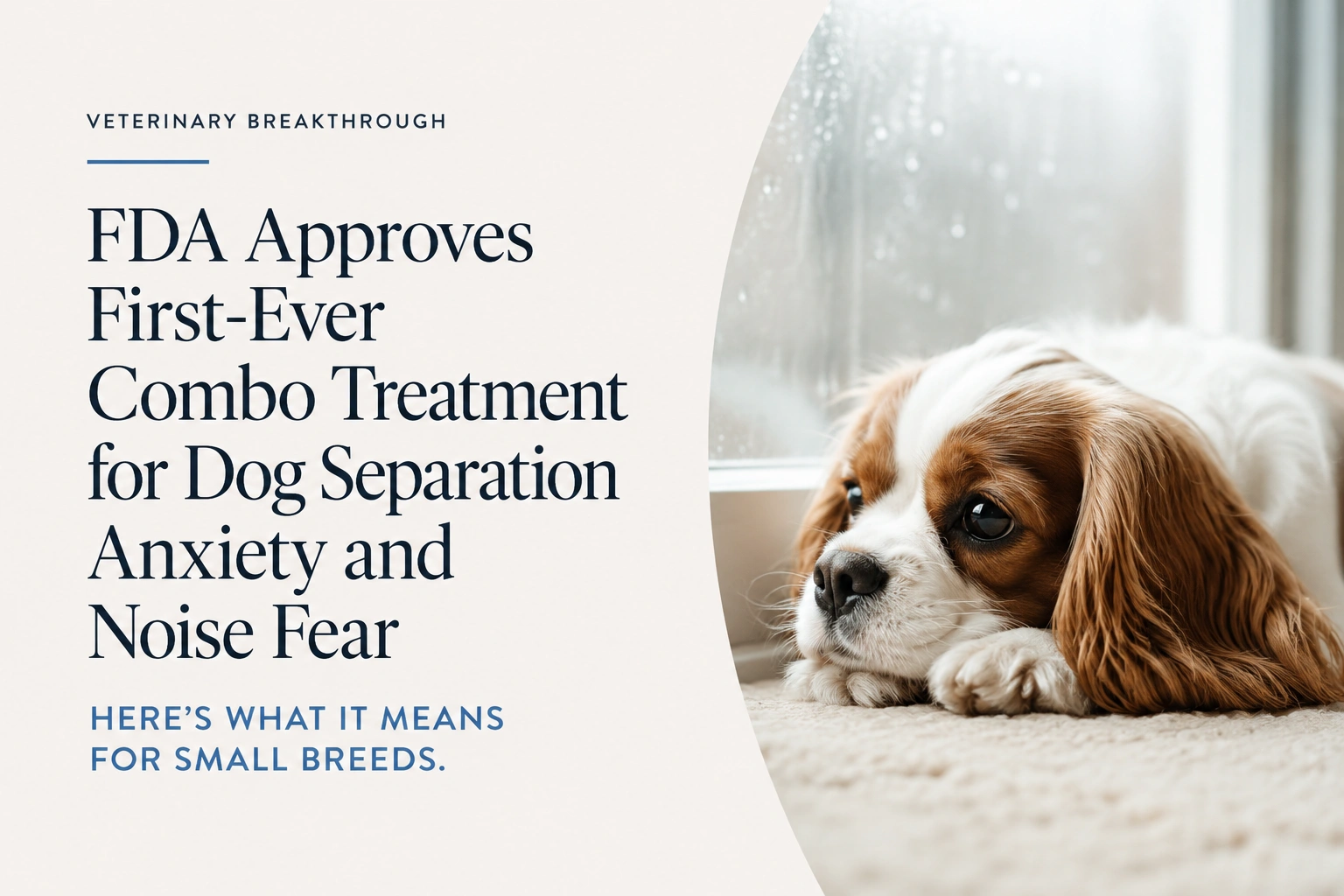
The FDA has approved Tessie (tasipimidine oral solution), the first medication ever cleared to treat both noise aversion and separation anxiety in dogs with a single product. For small, people-bonded breeds like Maltese, Yorkies, and Morkies — dogs that often struggle the most with being left alone — this is a genuinely useful new tool, not just a regulatory footnote.
What was approved
On May 6, 2026, the FDA approved Tessie for the treatment of noise aversion and separation anxiety in dogs. While the agency had already approved separate drugs for each condition individually, Tessie is the first product approved to treat both at once. It's sponsored by Orion Corporation, based in Finland, and is a prescription-only product.
Dogs with noise aversion are fearful of loud, sudden sounds like fireworks, thunderstorms, or traffic. Dogs with separation anxiety are fearful of being left alone. Both conditions can show up as whining, barking, howling, panting, trembling, hiding, destructive chewing, or accidents in the house — and according to the FDA, dogs experiencing either condition may also vomit or have other physical stress responses.
The active ingredient, tasipimidine, is an alpha-2 adrenoceptor agonist. In plain terms, it works by calming the part of a dog's nervous system responsible for the fight-or-flight response, without simply sedating the dog into sleepiness the way some older anxiety medications do.
Why one drug treating both conditions actually matters
Until now, a dog dealing with both noise fears and separation anxiety — which veterinary behaviorists say happens often, since the two conditions are frequently comorbid — needed separate medications or off-label combinations to manage each one. Veterinary behaviorist Christopher Pachel, DVM, told the veterinary publication dvm360 that having a single FDA-approved option for both is especially useful for dogs who are mid-progress in behavior modification training for one condition while still struggling with the other. The American Animal Hospital Association echoes this, noting that medication is meant to work alongside — not replace — an integrated behavior modification program.
The FDA's approval was based on two studies: one with 160 client-owned dogs with noise aversion, and a second following 224 dogs with separation anxiety over eight weeks. Both studies were conducted in real homes against real triggers rather than in a controlled lab setting, which matters because anxiety in dogs often looks different in a clinic than it does in a living room during an actual thunderstorm or actual goodbye at the door.
Reported side effects included vomiting, diarrhea, lethargy, and mild, temporary sedation-like signs such as reduced activity or slight incoordination.
The angle most coverage has missed: this is especially relevant for toy breeds
Most of the coverage on this approval has stayed general — useful for "dogs" broadly. But separation anxiety and noise sensitivity aren't evenly distributed across breeds. Small companion breeds like Maltese, Yorkies, and Morkies were bred for centuries specifically to bond closely with one person, which is exactly what makes them such wonderful companions — and also exactly why they're disproportionately prone to distress when left alone or startled by loud noise. A dog built to never want to leave your side is, almost by definition, a dog at higher risk for separation anxiety.
That doesn't mean every Maltese, Yorkie, or Morkie needs medication — most don't, especially with good early socialization and a calm departure routine. But for the families who do end up working with a vet on a tougher case, knowing that an option like Tessie now exists, and what it's actually approved to do, is worth having in your back pocket.
What this means if you're raising a small-breed puppy
Medication is never the first step — and the FDA itself notes that behavioral modification is often effective on its own. The best defense against separation anxiety in a toy breed actually starts in puppyhood: gradual alone-time training, a predictable routine, and not accidentally reinforcing clinginess in the early weeks home. We talk new families through exactly this when they bring home one of our Maltese puppies, Yorkie puppies, or Morkie puppies for sale in Austin, since prevention is so much easier than treating an established anxiety pattern later. If a fully-grown dog is already struggling, this kind of medication is a conversation to have with your own veterinarian, not something to start on your own. You can see all of our current small breed puppies for sale in Austin or reach out through our contact page with any questions before you bring a puppy home.
Frequently Asked Questions
What is Tessie, and what does it treat?
Tessie (tasipimidine oral solution) is an FDA-approved prescription medication for dogs, approved on May 6, 2026 as the first product to treat both noise aversion and separation anxiety in a single drug. It works by calming the brain's fight-or-flight response.
Why does it matter that one drug treats both conditions?
Noise aversion and separation anxiety frequently occur together in the same dog. Before Tessie, treating both usually meant combining separate medications. A single approved option simplifies treatment, particularly for dogs in the middle of behavior modification training for one condition while still affected by the other.
Are small breeds like Maltese, Yorkies, and Morkies more prone to separation anxiety?
These breeds were developed specifically as companion dogs that bond closely with one person, which can make them more susceptible to distress when left alone compared to breeds developed for independent work. Good early socialization and routine can prevent most cases from becoming a serious problem.
Is medication the first step for a dog with separation anxiety?
No. The FDA notes that behavioral modification is often effective on its own, and medication is typically reserved for cases where that alone isn't enough. Any decision to medicate should be made with a veterinarian, not started independently.
Sources: U.S. Food and Drug Administration, May 6, 2026; additional reporting via dvm360 and the American Animal Hospital Association.